Onshore Division
Thirteen rigs that walk.
Land drilling is won and lost between wells, not during them. Our onshore fleet is built around moving fast, cleanly and in the dark.
The rigs
One specification, thirteen times
AC electric
1,500 hp AC-electric drawworks with regenerative braking. Torque and speed are controlled rather than throttled, which is where both the footage and the fuel savings come from.
Walking systems
Hydraulic walking with the mast standing and the BOP in the air. The rig steps from slot to slot in hours rather than being torn down and rebuilt.
Automated floor
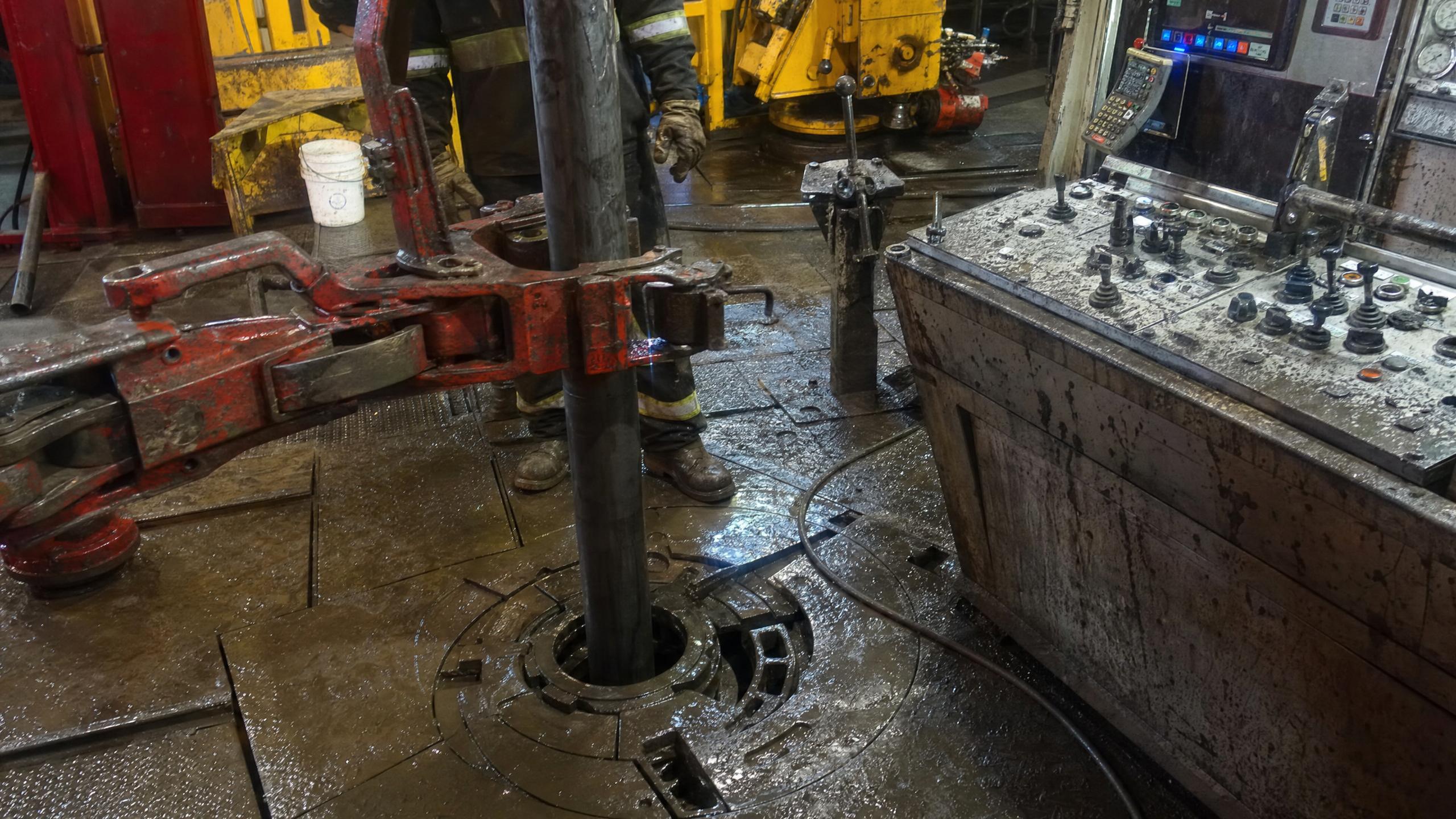
Iron roughneck, hydraulic catwalk and pipe racking on eleven of the thirteen. Tripping happens with nobody inside the red zone.
Hybrid and grid power
Battery peak-shaving on the whole fleet and highline connection wherever the operator has run power to the pad. Engines off is the target, not a bonus.
Closed-loop fluids
No reserve pits. Solids control, centrifuges and cuttings dryers keep the fluid in the system and shrink the pad footprint.
Winterised packages
The two Bakken rigs run enclosed floors, heated mud systems and winterised lines for continuous operation to −40°F.
Pad development
The move is the product.
On a twelve-well pad the drilling is the easy part. Twelve moves at thirty-four hours each is seventeen days of a rig sitting still; twelve moves at twenty-six hours is thirteen. That four-day difference is worth more than any single drilling optimisation on the pad.
So we run dedicated rig-move crews on a 24-hour rotation, we set every conductor before the rig arrives, and we treat the walk as a timed, rehearsed operation with its own procedure and its own post-job review.
- Dedicated 24-hour rig move crews, not the drilling crew doing double duty
- All conductors set before the rig walks onto the pad
- Timed and reviewed as a discrete operation
- BOP stays nippled up on the walk
- Lighting and traffic plan agreed with the landowner before mobilisation
Surface
Living next to a drilling rig
Noise
Sound walls on any pad within half a mile of a residence, and a measured limit at the property line rather than at the rig. Night-time limits are tighter than daytime and we hold to them.
Light
Directional shielded lighting aimed at the work rather than at the horizon. Crews get the light they need without turning the pad into a beacon.
Traffic
Agreed haul routes, dust suppression and a hard stop on non-emergency movements through the night in populated areas.
Water
Surface casing set and cemented to surface through every fresh water interval. Closed-loop fluids mean no reserve pit and no evaporation pond.
Land restoration
Pad restored to the condition agreed with the landowner before the rig demobilises, documented with photographs at handover.
Wildlife and seasonal windows
Seasonal restrictions built into the schedule at planning rather than negotiated when the rig is already on the pad.
District performance
Onshore, since start-up
| Metric | Permian | Eagle Ford | Bakken |
|---|---|---|---|
| Rigs operating | 7 | 3 | 2 |
| Wells delivered | 184 | 61 | 38 |
| Average lateral length | 11,240 ft | 8,900 ft | 10,100 ft |
| Spud to rig release | 14.2 d | 16.5 d | 18.9 d |
| Average pad move | 26 hr | 31 hr | 34 hr |
| Rig uptime | 97.1% | 96.8% | 95.2% |
| Diesel displaced by grid or battery | 48% | 36% | 21% |
How we take work.
Xtragate does not tender publicly and does not accept unsolicited enquiries. Programmes come to us through operators we already work for.